
Side Effect Risk Estimator
How Trial Size Affects Detection
Clinical trials often miss rare side effects because they're too small. Enter your trial size to see the probability of detecting a side effect that occurs in 1 in 10,000 patients.
Probability detected:
This means a side effect occurring in 1 in 10,000 patients has a chance of appearing in this trial size.
Why this matters: The article explains that trials with fewer than 400 participants have less than a 4% chance of detecting a side effect occurring in 1 in 10,000 patients. Real-world data from millions of users reveals these risks that trials miss.
When you take a new medication, the side effects listed on the label don’t tell the whole story. That’s because those warnings come from clinical trial data-a controlled, tightly monitored environment that rarely reflects how drugs behave in real life. Meanwhile, what actually happens to thousands of real people after a drug hits the market often reveals risks that trials missed entirely. Understanding the gap between these two types of data isn’t just for doctors or regulators. It’s critical for anyone taking prescription meds, because the difference can mean the difference between mild discomfort and a life-altering reaction.
Why Clinical Trials Don’t Show the Full Picture
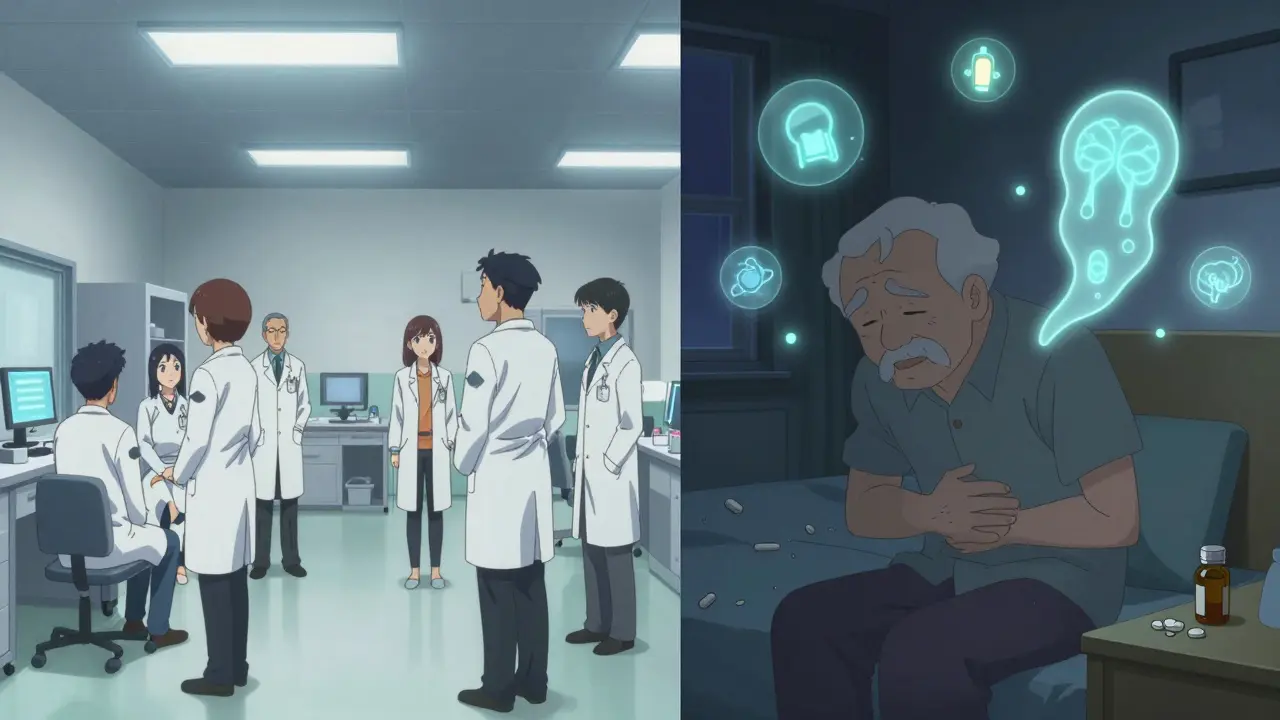
Clinical trials are designed to prove whether a drug works, not how it affects everyone. They follow strict rules: participants are carefully selected, often excluding older adults, pregnant women, people with other health conditions, or those taking multiple medications. The average Phase 3 trial enrolls fewer than 400 people. That’s not enough to catch side effects that happen in 1 in 1,000 or 1 in 10,000 patients. For example, the diabetes drug rosiglitazone was approved in 1999 based on clinical trial data that showed no major heart risks. But years later, real-world data from over 200,000 patients revealed a 43% higher risk of heart attacks. That risk was invisible in trials because the participants were too healthy, too young, and too few. Trials also use standardized tools like the Common Terminology Criteria for Adverse Events (CTCAE), which ranks side effects from mild to fatal. But even this system has limits. Events are only recorded during scheduled visits-usually once a week or month. If you feel dizzy at 2 a.m. after taking a new pill, and you don’t go to the clinic until next week, that event might not be logged properly-or at all.What Real-World Data Reveals That Trials Miss
Real-world data comes from the messy, unpredictable world where people actually live. It’s pulled from millions of electronic health records, insurance claims, pharmacy databases, and even patient-reported apps. The FDA’s Adverse Event Reporting System (FAERS) alone received over 2.1 million reports in 2022-up from 1.4 million in 2018. This data shows side effects that trials can’t see: rare reactions in older adults, interactions with other meds, long-term effects that take years to show up, and symptoms that only happen in certain environments-like fatigue that hits hardest at home, not during a clinic visit. Take GLP-1 agonists, used for diabetes and weight loss. Clinical trials reported nausea and vomiting as common side effects. But pharmacists on Reddit reported in 2023 that 78% of patients experienced worse gastrointestinal issues than listed-especially bloating and delayed stomach emptying, which weren’t tracked in trials. One patient said, “The trial asked if I had nausea. I said yes. They didn’t ask if I couldn’t eat for three days straight.” Real-world data also caught the link between fluoroquinolone antibiotics and disabling tendon damage. After analyzing 1.2 million patient records, regulators in Europe restricted these drugs in 2019. That discovery came from real-world patterns-not a single clinical trial.The Downside of Real-World Data
Real-world data isn’t perfect. It’s full of noise. Just because a side effect shows up in a database doesn’t mean the drug caused it. In 2018, a real-world study linked anticholinergic drugs to dementia. But later analysis showed patients taking these drugs were already more likely to have early dementia symptoms-like trouble sleeping or memory lapses-that led doctors to prescribe the drugs in the first place. The drug didn’t cause dementia; the underlying condition did. Another problem? Underreporting. Experts estimate only 2% to 5% of actual adverse events get reported to systems like FAERS. Why? Doctors are busy. Reporting takes an average of 22 minutes per case. A 2021 survey found only 12% of physicians report side effects regularly. And not all data is created equal. Electronic health records vary wildly across hospitals. Only 34% of recorded side effects contain enough detail for regulators to act on. A patient might write “felt weird” in their chart. That’s not useful. But if they say “chest tightness, 30 minutes after taking pill, improved after stopping,” that’s actionable.
How the FDA Uses Both Types of Data
The FDA doesn’t pick one over the other. It uses them together. Clinical trial data is the foundation. It’s what gets a drug approved. But now, 87% of new drug approvals between 2019 and 2021 included real-world evidence in post-marketing requirements. That means companies must track side effects after launch. The FDA’s Sentinel Initiative monitors 300 million patient records in near real-time. It can detect safety signals 6 to 12 months faster than traditional methods. In 2020, it helped confirm an increased risk of heart failure with pioglitazone-based on 10 years of real-world data from over 190,000 patients. And it’s getting smarter. Google Health’s 2023 study used AI to scan 216 million clinical notes and found 23% more drug-side effect links than traditional methods. Apple’s Heart Study, with 419,000 participants, showed how wearable tech can capture real-world data at trial scale.What This Means for You as a Patient
If you’re on a new medication, don’t assume the label tells you everything. Side effects not listed are not rare-they’re just unreported in trials. A 2022 survey by the National Patient Advocate Foundation found that 63% of patients experienced side effects not mentioned in their FDA-approved labeling. Of those, 41% were moderate to severe and affected daily life-like fatigue that kept them from working, or brain fog that made driving dangerous. If you notice something new, unusual, or persistent after starting a drug, write it down. Note when it happens, how long it lasts, and what else you’re taking. Then talk to your doctor. Don’t wait for your next scheduled visit. Also, consider using a side effect tracker app. The MyTherapy app, used by over 1.2 million people, found patients reported fatigue from immunotherapy drugs 27% more often than in clinical trials-because they tracked symptoms at home, not just during clinic visits.
The Future: Blending Trials and Real-World Data
The future of drug safety isn’t one system replacing the other. It’s both working together. More companies are now collecting real-world data during late-stage trials. Pfizer, Novartis, and others are asking participants to use apps to log symptoms daily. This creates a hybrid model: controlled data for approval, real-world data for long-term safety. The FDA’s 2023 update requires all new drug applications to include a plan for post-market real-world monitoring. That’s a big shift. It means companies can’t just say “we tested it in 400 people and it’s safe.” They have to prove they’ll keep watching. And regulators are getting better at sorting signal from noise. AI tools, better data standards, and patient-reported outcomes are making real-world data more reliable. But experts still agree: clinical trials are essential. They’re the only way to prove causality. Real-world data doesn’t replace them-it completes them.What You Can Do Today
- Read the label, but don’t trust it as the full story. - Track your symptoms in a notebook or app. Note timing, severity, and triggers. - Report side effects to the FDA through MedWatch, even if you’re unsure. Every report matters. - Ask your doctor: “Have you seen this side effect in other patients?” - Stay informed. The FDA updates drug safety info regularly. Check their website if you’re concerned. Drug safety isn’t a one-time event. It’s an ongoing conversation between science, patients, and systems that are still learning how to listen.Why are side effects in clinical trials different from real life?
Clinical trials use small, healthy, carefully selected groups under strict conditions. Real life includes older adults, people with multiple health issues, different diets, other medications, and daily stressors-all of which can change how a drug affects you. Trials are designed to prove if a drug works, not how it behaves in the messy reality of everyday life.
Can real-world data prove a drug causes a side effect?
Real-world data can suggest a link, but it can’t prove causation like a clinical trial can. That’s because real-world data includes confounding factors-like underlying illnesses or lifestyle habits-that might be the true cause. However, when multiple real-world sources show the same pattern over time, regulators take it seriously and often require label changes or warnings.
How often are side effects missed in clinical trials?
Studies show clinical trials miss up to 78% of serious side effects that appear in real-world use. This is mainly because trials are too small and too selective. Rare side effects-like a 1 in 5,000 risk of liver damage-simply won’t show up in a trial of 500 people.
Why don’t doctors report side effects more often?
Reporting adverse events to systems like FAERS takes about 22 minutes per case-and most doctors don’t have time. Many aren’t trained on how to report properly. Some don’t realize their report could help prevent harm to others. Only 12% of physicians report regularly, even though thousands of side effects go unreported each year.
Are newer drugs safer because of better monitoring?
Not necessarily. Newer drugs are approved faster, and many rely more on real-world data after launch. While this means we learn about risks quicker, it also means some side effects aren’t known until after thousands of people have taken the drug. The key difference today is that regulators expect ongoing monitoring-so we’re better at catching problems after the fact.
Can I trust the side effects listed on my prescription label?
The label lists the most common and serious side effects seen in trials. But it doesn’t include rare reactions, long-term effects, or side effects that only appear in certain populations. Many patients report side effects not on the label-especially fatigue, brain fog, or gastrointestinal issues. Always talk to your doctor if you notice something unusual, even if it’s not listed.





Comments (11)