
The Quick Breakdown: Which Program Does What?
Before you start hunting for codes, you need to know that not all "coupons" are the same. Some are designed to help you get a generic drug for pennies, while others are marketing tools from big pharma to steer you away from cheaper alternatives.| Program Type | Best For... | How It Works | Typical Impact |
|---|---|---|---|
| Third-Party Cards (e.g., GoodRx) | Generic medications | Negotiated pharmacy rates | High savings on generics (up to 65%+) |
| Manufacturer Coupons | Brand-name drugs | Point-of-sale rebates | Reduces copay, but doesn't lower list price |
| Prescription Assistance (PAPs) | Uninsured/Low income | Direct free medication | Highest per-patient savings |
When Third-Party Discount Cards Actually Win
If you are taking a generic version of a drug, GoodRx or Blink Health can be absolute game-changers. These aren't insurance plans; they are more like "Groupon for drugs." They negotiate prices with pharmacies, and you use their app to show a code to the pharmacist. For example, a study in *Circulation* showed that for a core three-drug generic regimen, these cards could drop the price from around $52.80 down to $18.60. That is a massive difference. In fact, some users on Reddit have reported saving nearly $50 on a 90-day supply of metformin just by bypassing their insurance copay. If you have a high-deductible plan, these cards often beat your insurance until you hit your deductible.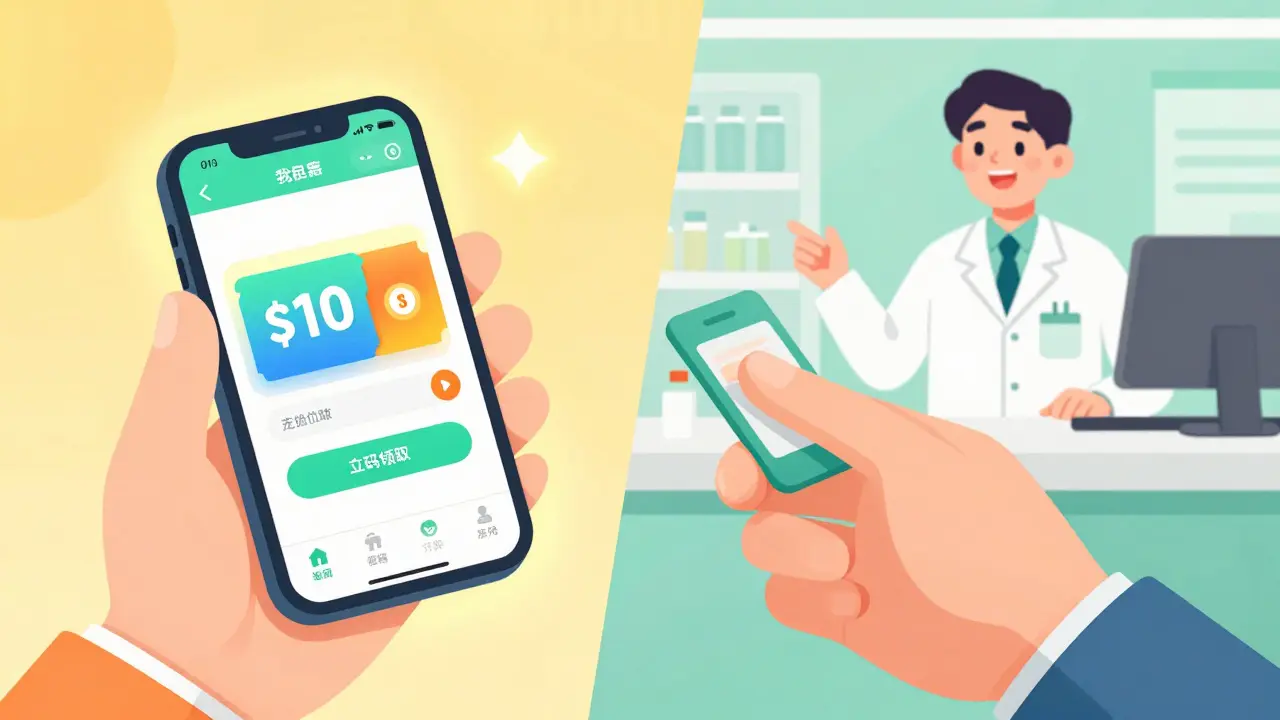
The Brand-Name Trap: Manufacturer Coupons
Manufacturer coupons are different. These come from the company that makes the drug. While they can make a $500 medication cost only $25 for a month, there is a catch. These coupons are often used to keep you on a brand-name drug when a cheaper, equally effective generic exists. Research from *JAMA Network Open* suggests that these coupons can actually induce demand for brand-name drugs by 60% or more. This is a bit of a double-edged sword: you save money today, but the overall cost to the healthcare system goes up because generics aren't being used. Also, if you are on Medicare Part D, be careful. Many manufacturer coupons are prohibited for Medicare patients unless they meet very specific criteria, and they might not count toward your catastrophic coverage thresholds.The Gold Standard for the Uninsured: PAPs
For those who are completely uninsured or have very low income, Prescription Assistance Programs (PAPs) are the most powerful tool. Unlike a coupon that gives you 20% off, PAPs often provide the medication for free. These are usually administered through nonprofits or clinics. In one Tennessee free clinic study, 61 patients saved a staggering $222,563 over 13 months-that is an average of $3,649 per patient. The downside? The paperwork. Unlike an app you download in seconds, PAPs require eligibility verification, income proof, and often several hours of administrative work to get approved.
How to Use These Tools Without Getting Confused
Using these programs isn't always as simple as scanning a QR code. Many people experience "pharmacy friction" where the pharmacist isn't familiar with a specific discount card or doesn't know how to process a manufacturer code. To get the best result, follow these steps:- Check the generic name: Don't just search for the brand name. Search for the chemical name of the drug to find the cheapest generic options on discount apps.
- Compare your copay: Always ask the pharmacist, "What is my insurance copay, and what is the cash price with this discount card?" Sometimes the card is actually cheaper than your insurance.
- Verify Medicare rules: If you are a senior, check if the coupon is compatible with your Part D plan to avoid unexpected bills later in the year.
- Ask about therapeutic substitution: Talk to your doctor about whether a different drug in the same class (like switching from one beta-blocker to another) could save you 10-20% more.
The Future of Drug Costs: Will Coupons Become Obsolete?
We are seeing a shift in how medications are priced. The 2024 Inflation Reduction Act has introduced Medicare drug negotiations that may cap out-of-pocket costs at $2,000 annually starting in 2025. This could make some discount programs less necessary for seniors. Additionally, we are seeing a rise in AI-driven price comparison tools. Some major pharmacy chains are piloting software that analyzes your specific insurance benefits in real-time to tell you the cheapest way to pay. The goal is to move away from "hunting for coupons" and toward a system where the lowest price is automatically applied.Can I use a discount card and insurance at the same time?
No. You generally have to choose one or the other for a single prescription. You cannot "stack" a third-party discount card on top of an insurance copay. However, you can compare both and use whichever one is cheaper at the pharmacy counter.
Are manufacturer coupons the same as discount cards?
No. Manufacturer coupons are provided by the drug's creator and are usually for brand-name meds to lower your copay. Discount cards (like GoodRx) are independent services that negotiate lower prices with pharmacies, mostly for generic drugs.
Do these programs work for all medications?
They work best for generics. For brand-name drugs, the savings are often much smaller-sometimes only 6% to 12%-unless you have a specific manufacturer coupon that drastically reduces the cost.
How do I find a Prescription Assistance Program (PAP)?
PAPs are typically found through the drug manufacturer's website under "Patient Assistance" or through community health clinics and nonprofits like NeedyMeds. Be prepared to provide proof of income and insurance status.
Will using a discount card affect my insurance coverage?
Using a third-party discount card means the cost does not count toward your insurance deductible or out-of-pocket maximum. If you are close to hitting your deductible, it might be smarter to pay the insurance copay instead.




Comments (15)