
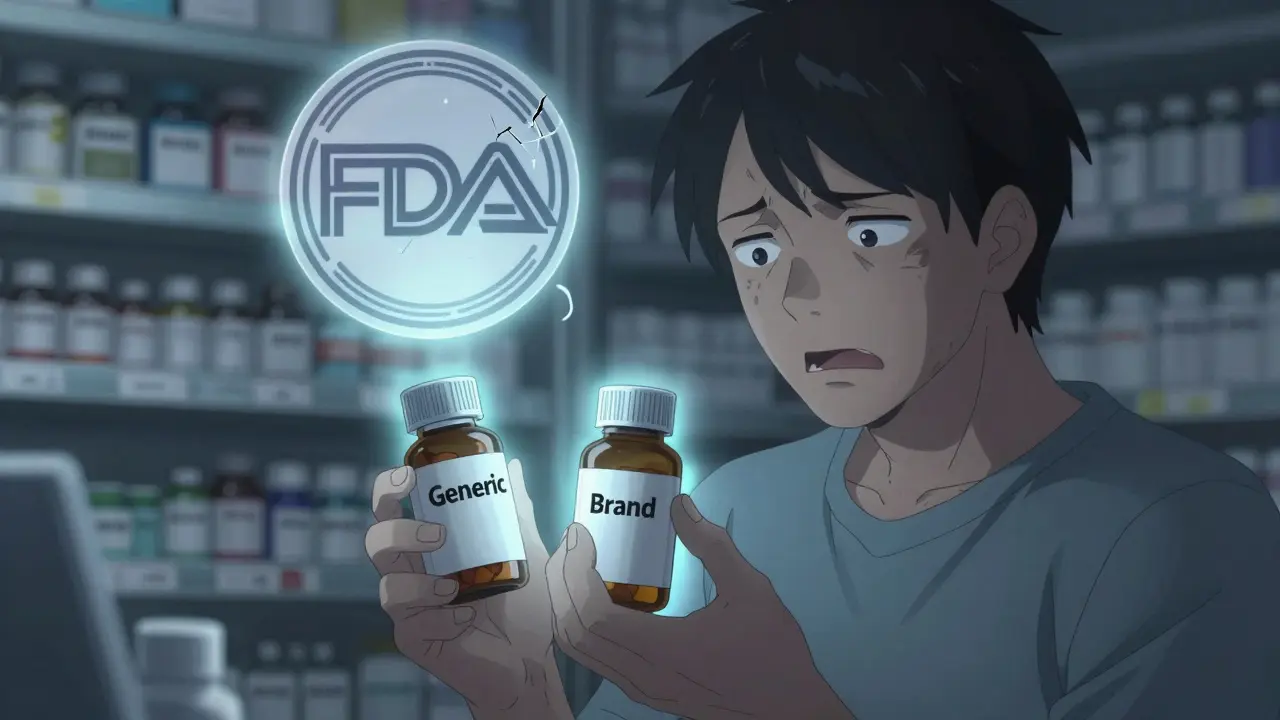
When you pick up a prescription, you might not think twice about whether it’s a brand-name drug or a generic. After all, the FDA says they’re the same. But if you’ve ever switched from a brand to a generic and suddenly felt off-more tired, anxious, or nauseous-you’re not alone. Thousands of people report changes after switching, and some even stop taking their medication altogether. So, are generics less safe? Or is something else going on?
What the FDA Actually Requires
The FDA doesn’t just approve generics because they’re cheaper. They require proof of bioequivalence. That means the generic must deliver the same amount of active ingredient into your bloodstream as the brand-name version, within the same time frame. The acceptable range? Between 80% and 125% of the brand’s absorption rate. That’s a 45% window. For most drugs, that’s fine. But for drugs with a narrow therapeutic index-like warfarin, levothyroxine, or phenytoin-even small differences in absorption can matter.
Here’s the catch: bioequivalence is tested in healthy volunteers, not in people with chronic conditions. And it’s based on average absorption, not individual response. So while the average person may see no difference, someone with sensitive metabolism or gut issues might.
Are Adverse Reactions Higher with Generics?
Studies give mixed answers. A 2018 analysis of 38 clinical trials published in PLOS Medicine found no significant difference in safety or effectiveness between generics and brand-name drugs for heart medications, diabetes drugs, and osteoporosis treatments. But here’s the twist: when researchers looked at psychiatric drugs like escitalopram and sertraline, they found slightly higher rates of hospitalization with authorized generics-versions made by the original brand under a different label. The researchers didn’t blame the drug itself. They pointed to something called perception bias.
People who know they’re taking a generic are more likely to notice and report side effects. In one study, patients given identical placebo pills were told one was a brand-name drug and the other a generic. The ones told they were taking the generic reported more side effects-even though the pills were identical. This isn’t just in your head; it’s a documented psychological phenomenon called the nocebo effect.
But What About the Reports?
The FDA’s Adverse Event Reporting System (FAERS) gets hundreds of thousands of reports every year. A 2018 analysis of 27,196 reports for four common drugs-amlodipine, metoprolol, losartan, and simvastatin-showed that generics made up a large portion of reports. But here’s what’s surprising: authorized generics (made by the brand company) had far fewer reports than third-party generics. That suggests the issue isn’t the active ingredient-it’s the manufacturer.
And then there’s the Ohio State University study from 2022. It found that generics made in India were linked to 54% more severe adverse events-hospitalizations, disabilities, even deaths-compared to those made in the U.S. The study focused on older, mature generics that had been on the market for years. Why? Because quality control can slip over time, especially with supply chains stretching across continents.
The FDA says 63% of generic manufacturing facilities are outside the U.S., mostly in India and China. While the agency inspects these sites, it’s impossible to check them all every year. And inspections don’t always catch subtle issues like inconsistent particle size, unstable coatings, or impurities that don’t show up in standard bioequivalence tests.

Real Patient Stories
Reddit threads are full of them. One user wrote: “I switched from Synthroid to generic levothyroxine and my TSH jumped from 1.8 to 8.2. I felt like I was in a fog. Went back to brand, and within weeks, I was myself again.” Another: “Generic bupropion gave me insomnia and panic attacks. Brand didn’t.”
These aren’t rare. A 2022 Consumer Reports survey of over 2,000 people found that 28% experienced different side effects after switching to a generic. And a 2016 study showed that 54% of patients on a generic-labeled placebo stopped taking it within a week-compared to 33% on the brand-labeled placebo. Even when the drug is identical, perception changes behavior.
Why Some Drugs Are More Risky
Not all drugs are created equal. For drugs like:
- Levothyroxine (thyroid hormone): A 10% difference in absorption can throw off thyroid levels, causing fatigue, weight gain, or heart palpitations.
- Warfarin (blood thinner): Small changes in absorption can mean the difference between clotting and bleeding.
- Phenytoin (seizure control): Too little = seizures. Too much = toxicity.
- Prograf (tacrolimus) (transplant drug): Even tiny variations can trigger organ rejection.
For these, the FDA and medical groups like the American College of Physicians recommend sticking with one manufacturer. That’s why doctors sometimes write “Dispense as Written” on prescriptions. It’s not about cost-it’s about consistency.
Manufacturing Matters More Than You Think
The active ingredient in a generic is the same. But what about the fillers? The coating? The binders? These inactive ingredients can cause reactions in people with allergies or sensitivities. One patient might react to cornstarch in one generic, while another reacts to dye in a different version.
Pharmacists often see patients who say, “I’ve been on this drug for years, but the new generic made me sick.” Turns out, it’s not the same manufacturer. Even if it’s the same generic name, different companies use different inactive ingredients. And the FDA doesn’t require them to match.
That’s why switching between generic brands-even if both are “generic”-can trigger side effects. It’s not the drug. It’s the delivery system.

What Does the Science Say Now?
The most recent data from Harvard and Brigham and Women’s Hospital suggests that for the vast majority of patients, generics are just as safe. A 2023 study in JAMA Network Open found that genetic differences-not the generic itself-explained why some people had bad reactions. People with certain gene variants (like CYP2D6 poor metabolizers) had 2.3 times higher risk of side effects with generic venlafaxine. That’s personal. Not generic.
Meanwhile, the FDA’s Sentinel Initiative now monitors 300 million patient records. Early results show no widespread safety crisis. In fact, for simvastatin, patients on the generic had lower rates of treatment discontinuation than those on the brand. Why? Because the generic was better tolerated.
What Should You Do?
If you’re taking a medication with a narrow therapeutic index-thyroid, blood thinners, seizure meds-stick with one brand or manufacturer. Ask your pharmacist if your generic is made by the same company each time. If you notice new side effects after switching, don’t assume it’s all in your head. Talk to your doctor. Request a switch back.
For most other drugs-antibiotics, blood pressure pills, statins-generics are safe and effective. The evidence is clear: the difference isn’t in the active ingredient. It’s in perception, manufacturing quality, and inactive ingredients.
And if cost is a concern, remember this: generics make up 90% of prescriptions in the U.S. and cost a fraction of the brand. They save billions. But they’re not magic. They’re medicine. And like all medicine, they need careful handling.
What’s Changing?
The FDA is moving toward more rigorous post-market studies for complex generics-like inhalers, topical creams, and extended-release pills. By 2027, 75% of these drugs will require real-world outcome tracking. That’s new. That’s progress.
And research into pharmacogenomics-how your genes affect how you respond to drugs-could one day let doctors match you to the right generic based on your DNA. No more guessing. No more side effects.
For now, the message is simple: generics are safe for most people. But not all generics are equal. And your body might know that before you do.




Comments (15)