

Graves’ disease isn’t just an overactive thyroid. It’s your immune system turning against your own body, tricking your thyroid into pumping out too much hormone-and the consequences can be serious if left unchecked. About 80% of all hyperthyroidism cases in the U.S. are caused by this condition, making it the most common reason for an overworked thyroid. It hits women seven times more often than men, especially between ages 30 and 50. And while it starts in the neck, its effects ripple through your heart, your eyes, your skin, and even your mental health.
What Exactly Happens in Graves’ Disease?
Your thyroid is a small butterfly-shaped gland at the base of your neck. It controls how fast your body uses energy, how you feel, and even how your heart beats. In Graves’ disease, your immune system makes faulty antibodies called thyrotropin receptor antibodies (TRAb). These antibodies act like fake keys, locking onto your thyroid’s receptors and forcing it to overproduce hormones-mainly T4 and T3.
This isn’t just a numbers game. When your TSH (thyroid-stimulating hormone) drops below 0.4 mIU/L and your free T4 rises above 1.8 ng/dL, your body is in hyperthyroid overdrive. Symptoms don’t wait for lab results. You might feel your heart racing at rest, your hands shaking, your weight dropping even when you’re eating more, or your sleep shattered by anxiety. Many people think it’s stress, menopause, or a panic disorder-delaying diagnosis by 6 to 12 months on average.
The Three Signs That Point to Graves’
Not all hyperthyroidism is the same. Graves’ has a signature trio of symptoms that set it apart:
- Hyperthyroidism-the hormonal chaos: sweating, tremors, fast heartbeat, weight loss, irritability.
- Graves’ ophthalmopathy-eye changes in 25% to 50% of cases. Your eyes may bulge, feel gritty, or become red and swollen. In 3% to 5% of cases, vision is threatened by pressure on the optic nerve.
- Dermopathy-rare but telling. Thick, red, lumpy skin on the shins or tops of feet, called pretibial myxedema, affects just 1% to 4% of patients.
The eye symptoms often get worse after treatment starts, even when thyroid levels normalize. That’s why specialists now treat the thyroid and the eyes as two separate problems needing different strategies.
Why PTU? The Role of Propylthiouracil in Treatment
There are three main ways to treat Graves’ disease: antithyroid drugs, radioactive iodine, or surgery. Antithyroid drugs are usually the first step. Two are used widely: methimazole and propylthiouracil (PTU).
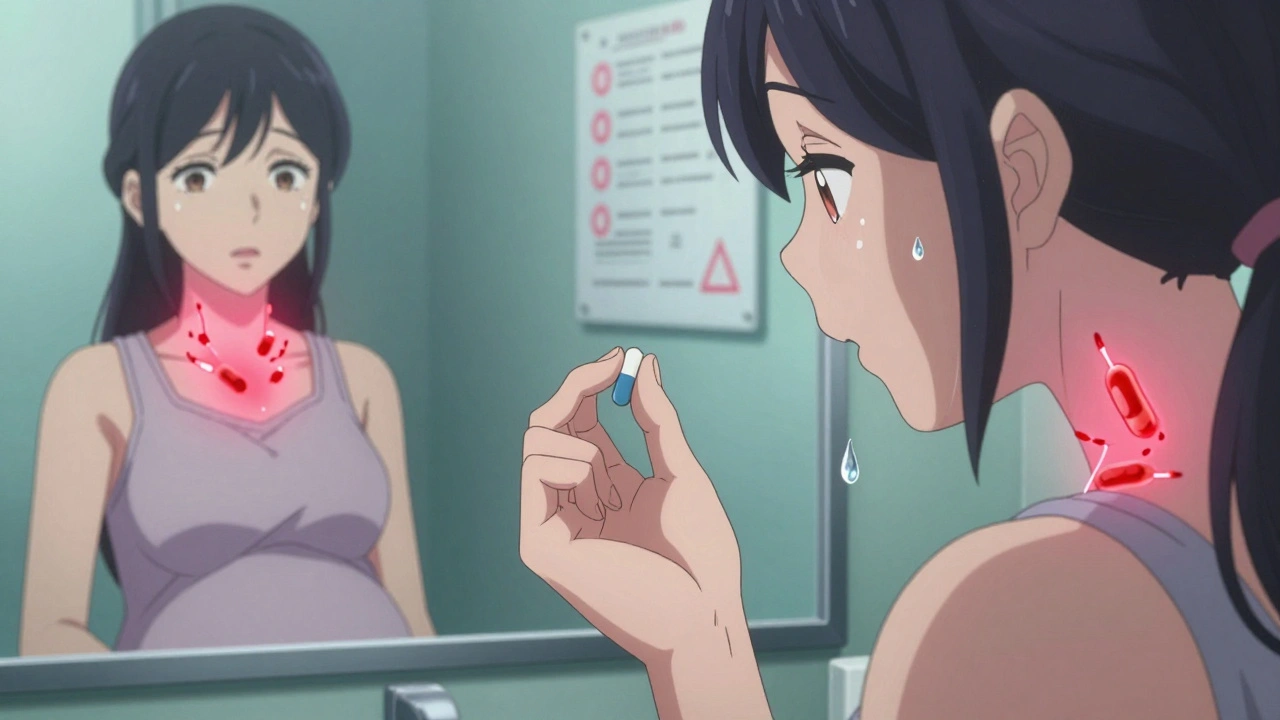
Methimazole is the go-to for most adults. It’s taken once a day, works well, and has fewer serious side effects. But PTU has one critical advantage: it’s safer in early pregnancy. The FDA recommends it for the first trimester because methimazole carries a higher risk of birth defects. That’s why pregnant women with Graves’ often switch to PTU early on.
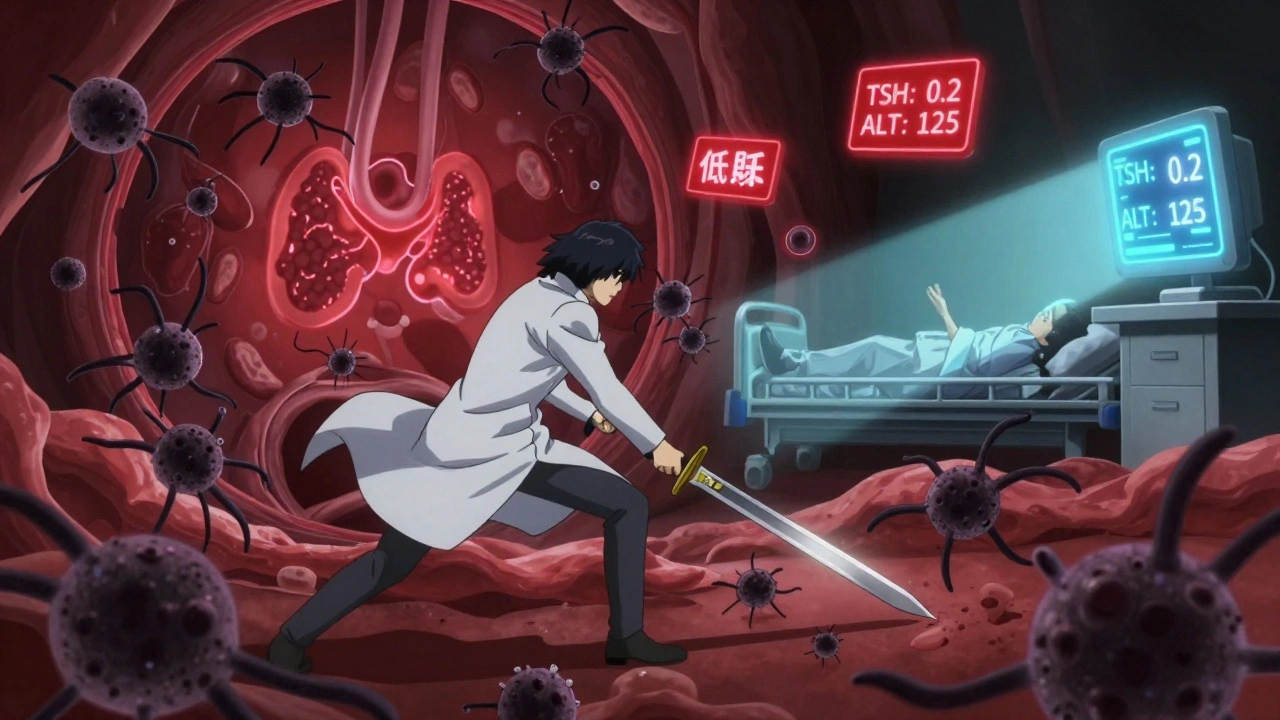
But PTU isn’t without risks. It can cause severe liver damage in about 0.2% to 0.5% of users. That’s rare, but it’s real. Some patients see their liver enzymes spike-ALT levels jumping from a normal 30 to over 120. When that happens, doctors stop the drug immediately. Patients on PTU need monthly liver function tests. Many say the constant blood draws are stressful, even when the drug works.
PTU also causes taste changes in 32% of users and joint pain in 18%. Still, for some, it’s the only option that keeps them alive and healthy-especially during pregnancy or when methimazole fails.
How Treatment Works: Dosing, Monitoring, and Timeline
PTU treatment usually starts at 100 to 150 mg three times a day. For severe cases or thyroid storm, doses can go as high as 600 to 800 mg daily. It’s not a quick fix. It takes weeks for hormone levels to drop. Most people feel better within 3 months, but full control takes 12 to 18 months.
During that time, you’ll get blood tests every 4 to 6 weeks. Doctors watch for:
- Thyroid hormone levels (TSH, free T4, free T3)
- Liver enzymes (ALT, AST)
- White blood cell count (to catch agranulocytosis-a rare but dangerous drop in infection-fighting cells)
If you develop a sore throat, fever, or yellowing skin, stop PTU and call your doctor immediately. These aren’t side effects to ignore. They’re red flags.
After 12 to 18 months, your doctor might try to wean you off. About 30% to 50% of people stay in remission. But for 40% to 60%, the disease comes back within a year of stopping meds. If it does, you’ll need to choose between long-term drug therapy, radioactive iodine, or surgery.
When PTU Isn’t Enough: Other Options
Not everyone responds to drugs. Some people can’t tolerate them. Others want a permanent fix.
Radioactive iodine (I-131) is the most common long-term solution. It destroys overactive thyroid tissue. One dose, and in 80% to 90% of cases, the hyperthyroidism is gone. But it almost always leads to lifelong hypothyroidism-you’ll need daily thyroid hormone pills forever. It’s not for pregnant women or those planning pregnancy soon.
Thyroidectomy (surgery to remove the thyroid) is fast and effective-95% success rate. But it’s invasive. Risks include damage to the voice box (1%) or parathyroid glands (1% to 2%), which control calcium. Recovery takes weeks. It’s often chosen for large goiters, cancer suspicion, or when other treatments fail.
For eye problems, standard treatments like steroids often aren’t enough. New drugs like teprotumumab have changed the game. Approved in 2021, it reduces bulging eyes by 71% in clinical trials. But it costs around $150,000 per course and requires weekly infusions. Not everyone can access it.
Who’s at Risk? And Why Does It Happen?
Graves’ isn’t random. Genetics play a huge role. If a close relative has it, your risk jumps. Twin studies show heritability near 79%. Women are far more likely to get it, especially after pregnancy-5% to 10% develop Graves’ in the year after giving birth.
Smoking doesn’t just hurt your lungs. It doubles your chance of severe eye complications. Stress, infections, and recent illness can trigger it in people with a genetic predisposition. Even geography matters: Finland has 10 times more cases than China.
Testing for TRAb antibodies is now standard. Levels above 10 IU/L mean you have an 80% chance of relapse after stopping meds. That’s why doctors now use it to predict outcomes-not just confirm diagnosis.
Living With Graves’ Disease: The Real Daily Struggle
Patients don’t just need meds. They need support. A 2023 survey of over 1,200 people found 78% struggled with anxiety and insomnia. Weight loss wasn’t welcome-it was terrifying. Many felt isolated because their symptoms were invisible.
Even after thyroid levels normalize, 40% still deal with eye discomfort, fatigue, or brain fog. Some say their life never fully goes back to how it was before diagnosis. That’s why multidisciplinary care matters: endocrinologists, ophthalmologists, mental health counselors, and patient groups all play a role.
Organizations like the Graves’ Disease and Thyroid Foundation offer 24/7 helplines and peer support. Online communities like Reddit’s r/GravesDisease have over 12,500 members sharing tips, horror stories, and victories. One person wrote: “PTU saved my pregnancy, but the liver checks broke me. I cried every time I had to draw blood.”
The Future: What’s Next for Graves’ Treatment?
Science is moving fast. In 2022, the FDA approved the first home thyroid monitor (ThyroidTrack), letting patients track TSH without going to a lab. It’s still in research use, but it could change how we manage chronic thyroid disease.
Researchers are testing drugs that block the TSH receptor directly-like K1-70. Early results show 85% of patients return to normal without becoming hypothyroid. That’s huge. Other trials are using rituximab, a drug that empties the immune system of the bad B-cells causing the attack. In refractory cases, it’s achieving 60% remission.
And the NIH just launched a $12.5 million Precision Medicine Initiative to predict who responds to what treatment based on their genes. If you have the HLA-DR3 marker, your risk triples. That kind of data could one day tell you whether to start with PTU, methimazole, or jump straight to radioactive iodine.
For now, PTU remains a lifeline-for pregnant women, for those with severe disease, and for people who can’t take other drugs. It’s not perfect. But when used carefully, with close monitoring, it saves lives.
When to Call Your Doctor
Even on treatment, watch for warning signs:
- Heart rate over 100 bpm at rest
- Fever above 100.4°F
- Jaundice (yellow skin or eyes)
- Sudden sore throat or mouth ulcers
- Severe joint pain or rash
These aren’t normal. They’re emergencies. Don’t wait for your next appointment. Call your endocrinologist or go to urgent care.





Comments (11)