

When you’re pregnant, even the smallest decision about what you put on your skin can feel huge. That rash? That breakout? That itchy belly? You want relief-but you’re terrified of harming your baby. The good news: topical medications are often much safer than pills or injections because they barely enter your bloodstream. But not all creams are created equal. Some are fine. Others? Avoid them completely.
Why Topical Creams Are Usually Safer Than Pills
Most creams, lotions, and gels you apply to your skin don’t get absorbed deeply. Only 1% to 10% of the active ingredient typically enters your blood-compared to 90%+ when you swallow a pill. That’s why doctors often recommend topical treatments first for pregnant women. A 2016 review in the Journal of Drugs in Dermatology found that topical dermatologic drugs are generally less risky than oral ones because they keep the medication mostly where it’s needed: on your skin. But here’s the catch: absorption isn’t the same everywhere. Your face, neck, armpits, and groin absorb more than your forearm or back. So even a “safe” cream can become risky if you slather it on large areas of thin skin for weeks on end.Acne Treatments: What’s Safe and What’s Not
Acne flares up in pregnancy for many women because of hormone shifts. But you can’t just grab your old acne cream. Retinoids-like tretinoin, adapalene, and isotretinoin-are off-limits. Even though topical retinoids don’t absorb much, case reports link them to birth defects when used in early pregnancy. The American College of Obstetricians and Gynecologists (ACOG) advises stopping these completely before trying to conceive. Good alternatives? Benzoyl peroxide and topical antibiotics like clindamycin and erythromycin. Benzoyl peroxide is classified as Category C (animal studies showed risk, no human data), but since it barely enters the blood and has been used safely for decades, most dermatologists consider it fine. Clindamycin absorbs about 4-5% through the skin, but studies show no harm to babies when used as directed. Azelaic acid (found in Azelex and Finacea) is another top pick. It’s Category B, meaning animal studies showed no risk, and it’s effective for both acne and melasma-the dark patches many pregnant women get on their face. One user on WhatToExpect.com reported her “pregnancy mask” cleared up completely with azelaic acid and zero side effects.Corticosteroids: Use Carefully, Not Constantly
If you have eczema, psoriasis, or allergic reactions, hydrocortisone cream is often the go-to. Low-potency hydrocortisone (0.5%-1%) is generally safe for short-term use. Many pregnant women report relief from itching without issues. But potency matters. Stronger steroids like clobetasol or betamethasone can cross the placenta in small amounts. The Journal of Drugs in Dermatology warns that very potent topical steroids, especially when used over large areas for long periods, may be linked to lower birth weight. Experts recommend using the weakest effective strength for the shortest time possible. Also, avoid applying steroids to your breasts if you’re breastfeeding-unless you wipe them off before feeding. A little gets into breast milk, and while it’s unlikely to harm the baby, it’s better to be cautious.Antifungal Creams: Yeast Infections Are Common-Here’s What Works
Vaginal yeast infections spike during pregnancy due to hormonal changes. But you don’t need to take pills. Topical antifungals are the first-line treatment. Clotrimazole, miconazole, and nystatin are all considered safe. They’re not absorbed much and have been used for decades without evidence of harm. The European Academy of Dermatology and Venereology lists them as first-choice options. Avoid econazole during the first trimester. It’s been linked to rare birth defects in animal studies, and while human data is limited, it’s not worth the risk. Terbinafine and naftifine are second-line options-use only if your doctor says so.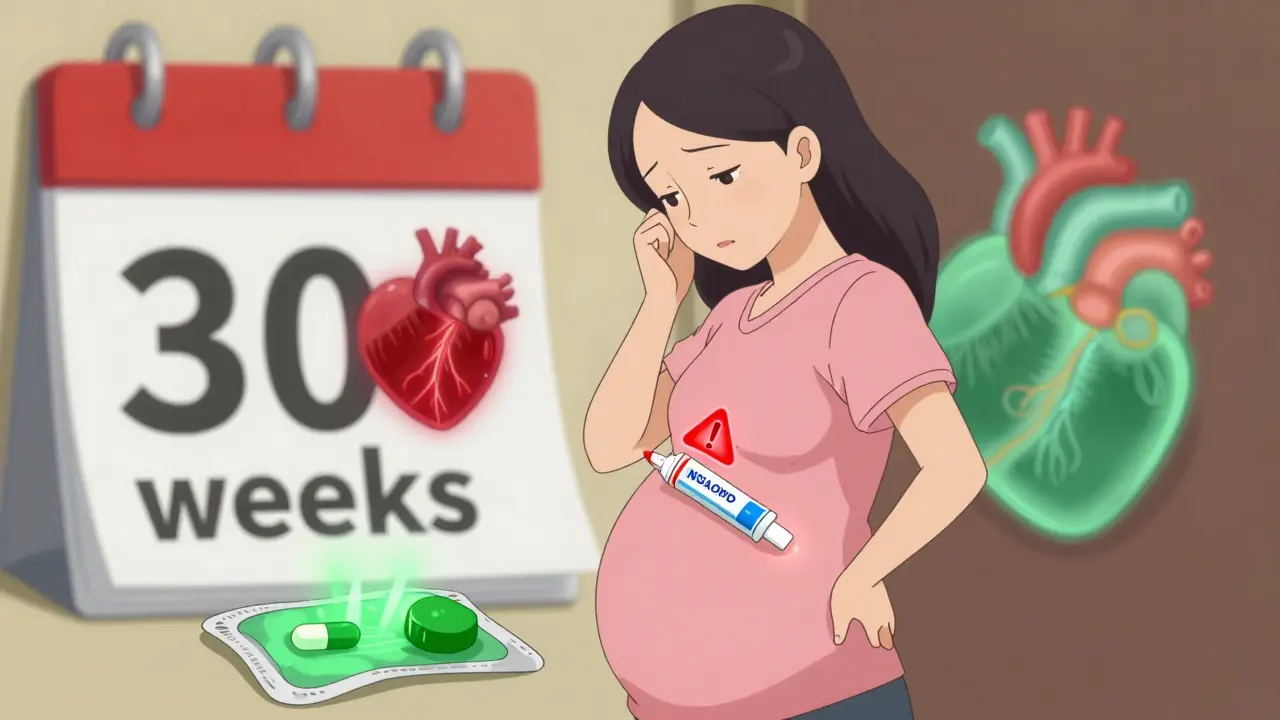
NSAID Creams: The Hidden Risk After 30 Weeks
You might think “topical ibuprofen” or “diclofenac gel” is harmless. After all, it’s just cream, right? But here’s the twist: even small amounts absorbed through the skin can affect your baby’s heart. After 30 weeks, NSAIDs (nonsteroidal anti-inflammatory drugs) can cause the ductus arteriosus-a blood vessel in the baby’s heart-to close too early. This can lead to serious heart problems. The American Academy of Family Physicians (AAFP) advises avoiding topical NSAIDs after 30 weeks, even if you’re only using a small amount. If you need pain relief for back pain or joint soreness, stick to acetaminophen (Tylenol) pills or cold packs. Topical NSAIDs might be okay before 30 weeks, but only if your doctor approves them.Antiviral Creams: Cold Sores and Herpes
If you get cold sores, acyclovir cream is safe. It’s been studied in pregnant women and shows no increased risk of birth defects. The European Academy of Dermatology and Venereology recommends it as a first-line treatment. Avoid podofilox and podophyllin resin. These are used for genital warts and can be toxic to the fetus. Even though they’re applied topically, they’re absorbed enough to cause serious harm.Moisturizers, Sunscreens, and Everyday Products
You don’t need to overhaul your entire skincare routine. Basic moisturizers, petroleum jelly, and fragrance-free lotions are perfectly safe. Look for products labeled “hypoallergenic” and “fragrance-free” to reduce irritation. Sunscreen? Essential. Pregnancy increases your risk of melasma (dark patches), and UV exposure makes it worse. Use mineral sunscreens with zinc oxide or titanium dioxide. They sit on top of the skin and don’t absorb. Chemical sunscreens (like oxybenzone) are debated, but the American Academy of Dermatology says they’re safe in pregnancy-just stick to mineral if you’re unsure.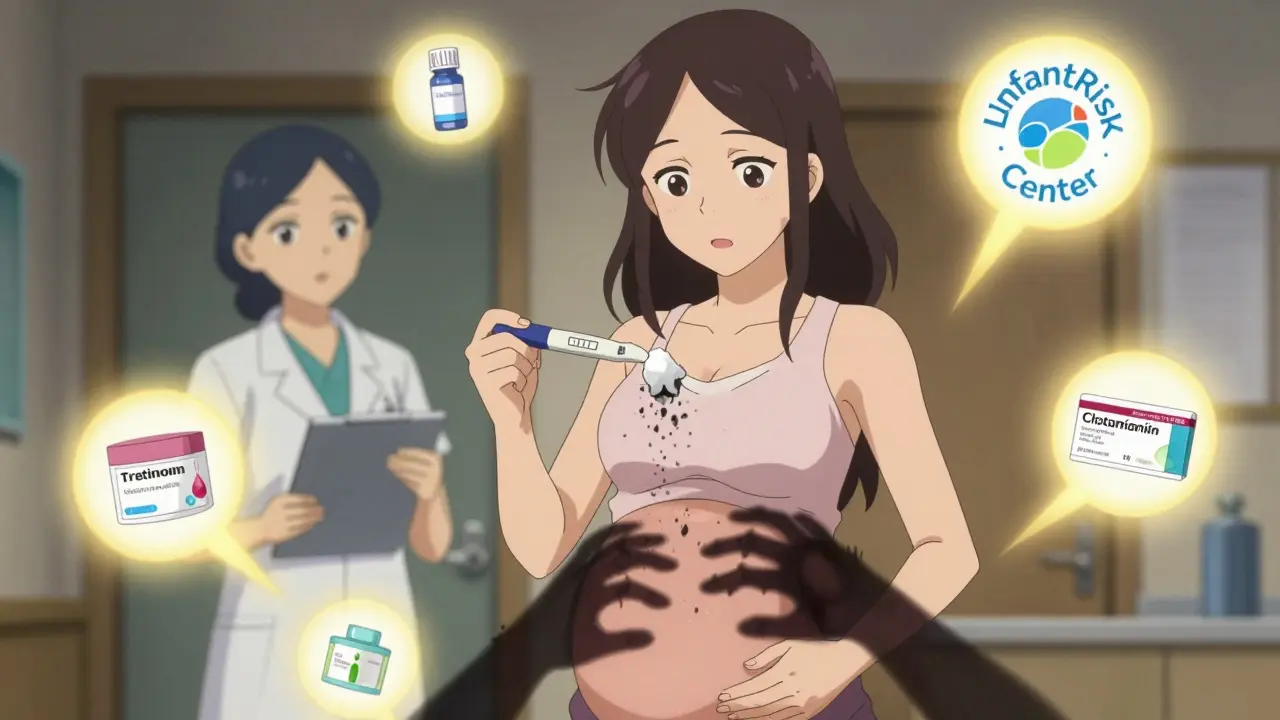
What to Do If You Accidentally Used Something Risky
If you used tretinoin or a strong steroid before realizing you were pregnant, don’t panic. The risk is low, especially if it was a small area for a short time. Most babies exposed to topical retinoids are born healthy. Talk to your OB-GYN or midwife. They can refer you to the InfantRisk Center, which handles over 1,200 pregnancy medication questions every month. They’ll help you understand your actual risk based on the product, amount used, and when you used it.How to Stay Safe: A Simple Checklist
- Do: Use low-potency hydrocortisone for eczema or itching
- Do: Try benzoyl peroxide or azelaic acid for acne
- Do: Use clotrimazole or miconazole for yeast infections
- Do: Apply sunscreen daily with zinc or titanium dioxide
- Don’t: Use retinoids (tretinoin, adapalene, isotretinoin)
- Don’t: Use topical NSAIDs (diclofenac, ibuprofen gel) after 30 weeks
- Don’t: Apply strong steroids (clobetasol) to large areas or thin skin
- Don’t: Use podofilox or podophyllin for warts
Why So Much Confusion?
Many women are unsure because product labels don’t help. In 2015, the FDA replaced the old A, B, C, D, X pregnancy categories with detailed narrative summaries. But most drug labels still use the old system-or skip pregnancy info entirely. A 2022 study found only 37% of topical dermatology products include clear pregnancy safety info. Plus, doctors aren’t always trained in this. Eighty-two percent of OB-GYNs consult dermatologists for skin issues in pregnancy, according to ACOG. That tells you how complex it is.Bottom Line: You Can Use Creams-Just Choose Wisely
You don’t have to suffer through rashes, acne, or itching during pregnancy. Many topical treatments are safe and effective. Stick to the basics: low-potency steroids, benzoyl peroxide, azelaic acid, clotrimazole, and mineral sunscreen. Avoid retinoids, strong steroids, and NSAIDs late in pregnancy. When in doubt, ask your doctor. Bring the product with you. Don’t guess. And remember: the goal isn’t to avoid all medications-it’s to use the right ones, the right way, at the right time.Is hydrocortisone cream safe during pregnancy?
Yes, low-potency hydrocortisone cream (0.5%-1%) is generally safe for short-term use during pregnancy. It’s commonly used for eczema, insect bites, and itching. Avoid using it on large areas or for long periods, and don’t apply it to your breasts if you’re breastfeeding unless you wipe it off before feeding.
Can I use acne cream while pregnant?
Some acne creams are safe, others aren’t. Benzoyl peroxide and topical antibiotics like clindamycin and erythromycin are considered safe. Avoid retinoids like tretinoin, adapalene, and isotretinoin-they’re linked to birth defects and should be stopped before conception. Azelaic acid is another good option that also helps with dark spots.
Is it safe to use antifungal cream for a yeast infection during pregnancy?
Yes. Clotrimazole, miconazole, and nystatin are first-line treatments for vaginal yeast infections and are safe during pregnancy. Avoid econazole in the first trimester and use it sparingly later. Terbinafine and naftifine are second-line options and should only be used if your doctor recommends them.
Can I use ibuprofen gel or diclofenac cream while pregnant?
Avoid topical NSAIDs like diclofenac or ibuprofen gel after 30 weeks of pregnancy. Even though they’re applied to the skin, they can still affect your baby’s heart by causing early closure of the ductus arteriosus. Before 30 weeks, they may be okay with your doctor’s approval, but acetaminophen or cold packs are safer choices.
What sunscreen is safe during pregnancy?
Mineral sunscreens with zinc oxide or titanium dioxide are the safest choice. They sit on top of the skin and don’t absorb into your bloodstream. Chemical sunscreens like oxybenzone are considered low-risk by the American Academy of Dermatology, but if you’re unsure, stick with mineral formulas to avoid any potential concerns.
What should I do if I used retinoid cream before knowing I was pregnant?
Don’t panic. The risk of birth defects from topical retinoids is very low, especially if you used a small amount for a short time. Contact your OB-GYN or call the InfantRisk Center-they track these cases and can give you personalized advice based on how much you used and when. Most babies exposed this way are born healthy.




Comments (9)