Government Response to Drug Shortages: Federal Actions and Policy Shifts in 2025-2026

published : Jan, 10 2026

Government Response to Drug Shortages: Federal Actions and Policy Shifts in 2025-2026

Drug shortages are no longer rare events-they’re a constant strain on hospitals, pharmacists, and patients.

As of late 2024, over 277 drugs remained in short supply across the U.S., according to Global Biodefense. These aren’t just obscure medications. They include life-saving antibiotics, chemotherapy agents, anesthetics, and even basic IV fluids like saline. Hospitals are scrambling. Pharmacists are spending hours each week tracking down alternatives. Patients are skipping doses or getting delayed treatments. And behind it all is a federal response that’s trying to catch up-but still missing the bigger picture.

The Strategic Active Pharmaceutical Ingredients Reserve (SAPIR) is the centerpiece of the current federal strategy.

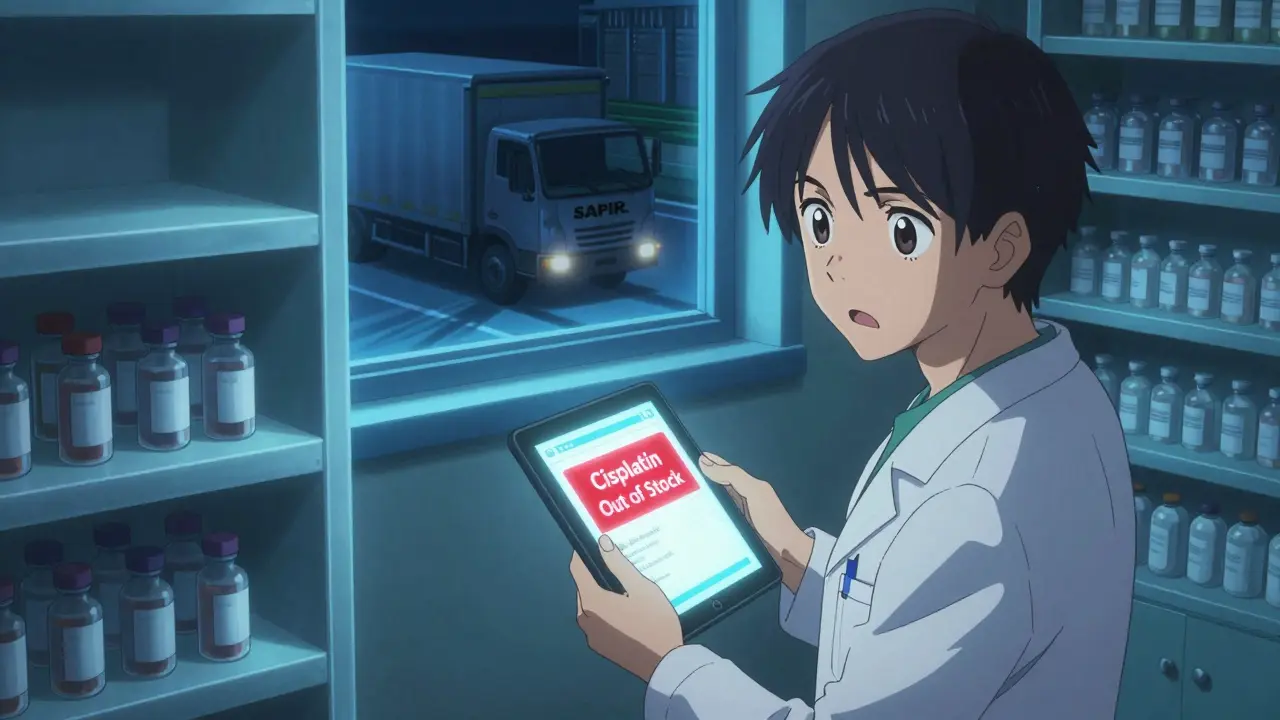
In August 2025, President Trump signed Executive Order 14178, expanding the Strategic Active Pharmaceutical Ingredients Reserve (SAPIR). This program doesn’t stockpile finished pills or injections. It stocks the raw chemical building blocks-active pharmaceutical ingredients (APIs)-needed to make 26 critical drugs. Why? Because APIs are cheaper to store, last 3 to 5 years longer than finished products, and are easier to transport than bulky vials. The goal is to have these materials ready to turn into medicine during a crisis.

The 26 drugs on the list include antibiotics like vancomycin, cancer drugs like cisplatin, and anesthetics like propofol. But here’s the problem: 98% of all drug shortages involve medications not on this list. Oncology drugs alone make up 31% of all shortages, yet only 4% of the SAPIR targets are cancer medications. That’s like stocking up on fire extinguishers but ignoring the fact that most fires start in the kitchen.

Manufacturing is still concentrated in just a few places-and that’s dangerous.

Seven out of ten sterile injectable drugs are made in just five facilities nationwide. One shutdown, one quality issue, one power outage-and suddenly, half the country runs out of a vital drug. The FDA says it resolves 85% of shortages by working with manufacturers to fix production issues or approve temporary imports. But that’s reactive. It doesn’t stop the next shortage from happening.

Even with $285 million in new CHIPS Act funding for domestic production, the U.S. is still falling behind. In 2024, the FDA approved 56 new manufacturing sites for critical drugs-but 42% of them were overseas, mostly in Ireland and Singapore. Why? Because building a new API plant in the U.S. takes 28 to 36 months to get FDA approval. In the EU, it takes 18 to 24 months. That’s a huge delay. And with just three companies controlling 68% of the sterile injectable market, there’s no real competition to keep supply stable.
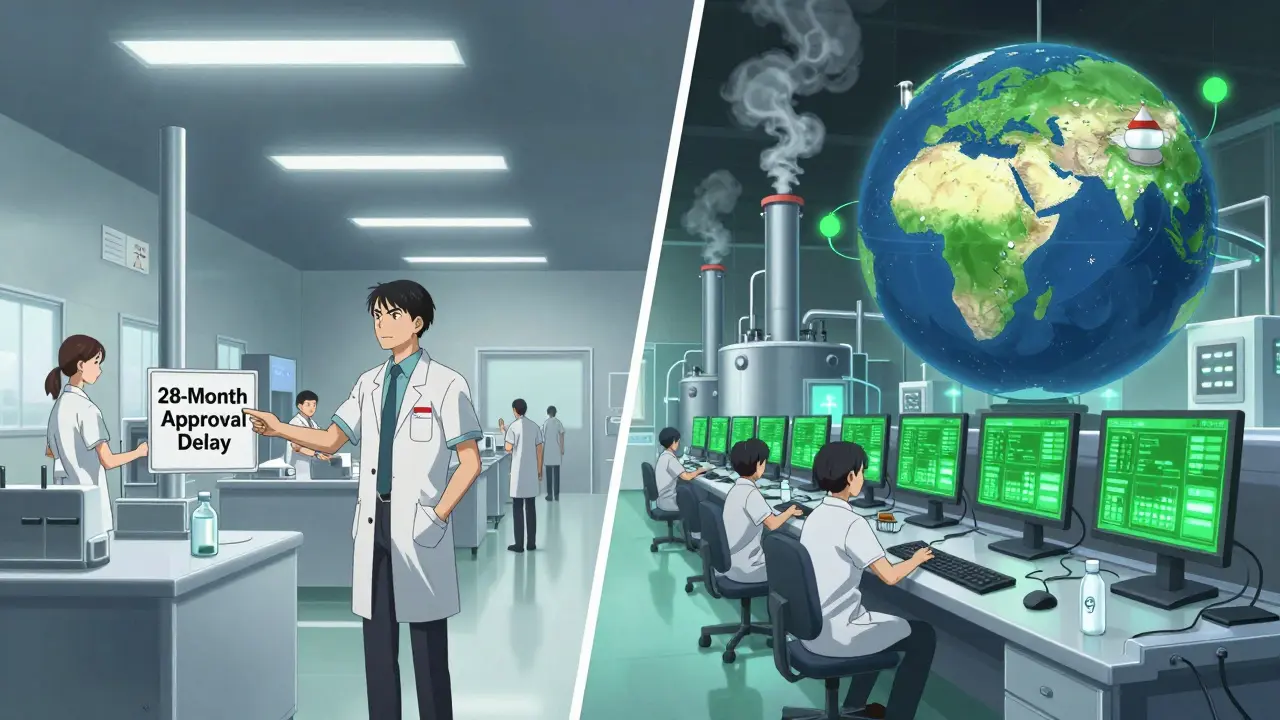
Split scene: a slow U.S. drug factory vs. a fast EU facility with glowing digital monitors.

Reporting requirements are weak-and that’s making shortages worse.

Since 2012, manufacturers have been legally required to tell the FDA six months in advance if they think a drug might run out. But only 58% actually do it. For small manufacturers-those with fewer than 50 employees-the compliance rate drops to just 18%. That means the FDA is often flying blind.

The FDA’s own internal review, leaked in October 2025, found that their current approach will prevent only 15% to 20% of projected shortages over the next three years. Meanwhile, the European Union has a centralized system that tracks shortages in real time and requires member states to maintain stockpiles. Since 2022, EU shortages have dropped by 37%. The U.S. has nothing close to that.

There’s a disconnect between policy and reality.

The federal government is spending money on stockpiling APIs, but it’s cutting funding for the very programs that could prevent shortages long-term. The 2026 HHS budget slashes $1.2 billion from FEMA’s emergency response and $850 million from state public health grants. Biomedical innovation funding from NIH dropped 18% between 2024 and 2025. These are the investments that build better manufacturing tech, like continuous production systems that can make drugs in days instead of months.

Even the tools meant to help hospitals are underused. The new HHS Coordination Portal, designed to give hospitals real-time visibility into drug supplies, has a usability score of just 2.1 out of 5. Only 28 of 50 states have fully implemented the supply chain mapping required by the 2025-2028 Action Plan. Rural hospitals say it takes them six months just to get the software working.

What’s actually working-and what’s being ignored?

One bright spot: the FDA’s Early Notification Pilot Program. Hospitals that signed up saw their shortage durations drop by 28%. Why? Because they reported problems early. That’s it. No fancy tech. No stockpiles. Just timely communication.

Another promising move: the FDA’s new expedited review pathway for second-source manufacturers. Right now, 14 companies are in line to start making versions of drugs that keep running out. If approved by Q2 2026, they could add redundancy for eight critical medications. That’s the kind of fix that actually reduces risk-not just moves the problem around.

But these are small steps. The real fix? Change the economics. Making a generic antibiotic or saline solution doesn’t pay well. Companies don’t invest in backup lines or extra inventory because there’s no profit in it. The AHA proposed Medicare payments to hospitals that maintain alternative supply chains. That’s a start. But until the government pays more for essential, low-margin drugs-or penalizes monopolies that control supply-shortages will keep coming.
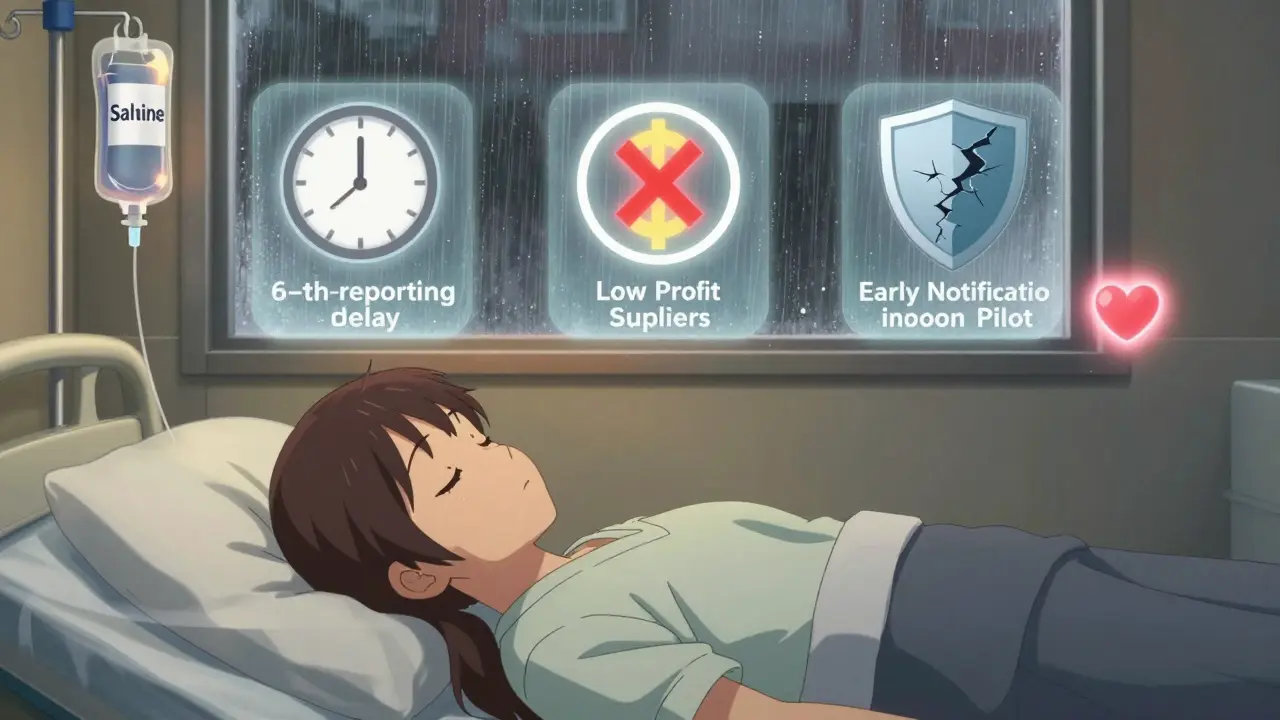
A patient in bed looks at floating icons representing drug shortage causes, an empty IV bag beside her.

The human cost is real-and growing.

Hospitals are spending an average of $1.2 million a year just managing shortages. Pharmacists are working 10+ hours a week tracking down drugs. In one case reported on Reddit, a pharmacist had to compound cisplatin from raw chemicals because the pre-made version wasn’t available. That’s not standard practice. That’s desperation.

Patients are skipping doses. A September 2025 survey found that 29% of Americans skipped medication because it wasn’t available-not because they couldn’t afford it. Cancer patients were hit hardest: 68% reported treatment delays or changes. One woman in Ohio had to delay her chemotherapy by three weeks because her oncologist couldn’t get the drug. She didn’t get sick because of the delay. But she lived with the fear for weeks.

What’s next? The road ahead is unclear.

The Drug Shortage Act (H.R.5316) is now in Congress. It would make it easier for pharmacists to use compounded versions of shortage drugs. That could help. But it doesn’t fix manufacturing. The Congressional Budget Office estimates it would reduce shortages by 15% to 20%-at a cost of $740 million over five years. That’s less than 0.1% of total U.S. drug spending.

Meanwhile, the FDA’s new AI-powered monitoring system is showing promise. By analyzing shipping data, batch records, and hospital orders, it can predict shortages with 82% accuracy 90 days ahead. That’s powerful. But if no one acts on the warnings, it’s just a fancy alarm with no one to hear it.

The bottom line: stockpiling isn’t enough.

The federal government is treating drug shortages like a logistics problem. They’re not. They’re an economic and structural problem. You can’t stockpile your way out of a system where making life-saving drugs isn’t profitable. You can’t outsource your way to safety when 80% of APIs come from China. And you can’t rely on hospitals to patch the cracks when they’re already overwhelmed.

The real solution needs three things: incentives for manufacturers to build redundant capacity, enforcement of reporting rules, and investment in faster, smarter production tech. Until then, shortages will keep happening. And the people paying the price will be the ones who need these drugs the most.

Comments (14)

Rebekah Cobbson

It's wild how we treat medicine like it's just another commodity. We don't stockpile toilet paper like this, but we act like running out of chemo or antibiotics is normal. The SAPIR sounds smart on paper, but if 98% of shortages aren't even covered, it's like bringing an umbrella to a hurricane.

I've seen pharmacists cry over missing saline bags. No one talks about that.

We need to pay for the stuff that saves lives, not just the stuff that makes money.

Audu ikhlas

USA is weak. China makes 80% of APIs? LMAO. We let them own our health? This is why we lost. Trump did good with SAPIR but its too little too late. We need to shut down all imports and build 1000 new plants. Now. No excuses. India and Singapore? They stealing our jobs. America first or die.

Also FDA is corrupt. 28 months to approve? That's bribery time. Burn it down.

Sonal Guha

98% of shortages outside SAPIR list. 31% oncology drugs but only 4% coverage. That's not policy its math failure. Reporting compliance at 18% for small firms? That's not negligence its systemic collapse. FDA's 15-20% prevention rate? That's a glorified bandaid. EU dropped shortages 37% with centralized tracking. We have a portal with 2.1/5 usability. What are we even doing here

TiM Vince

I worked in a rural ER last year. We ran out of propofol for three weeks. No one told us. No one warned us. We had to use ketamine for everything. It worked but it was terrifying. The system isn't broken. It's just... not designed for humans.

That Early Notification Pilot? That's the only thing that actually helped. Just talk to each other. It's not rocket science.

gary ysturiz

Let me break this down simple. Making life saving drugs doesn't pay well. So companies don't make extra. So we run out. So people suffer. So we spend more money fixing it later. It's a loop. We need to pay more for these drugs. Not just talk about it. Pay more. Make it worth their time. That's it. No magic. Just money.

And if you're a monopoly holding 68% of the market? You get fined. Hard. That's the fix.

Jessica Bnouzalim

Okay but have you seen the HHS Coordination Portal?? It's like someone built it in 2003 and forgot to update it. I tried to use it for my hospital last month and it crashed three times. Six months to get it working?? In 2025??

And the AI system that predicts shortages with 82% accuracy? That's AMAZING. But if no one has time to check the alerts because they're already overwhelmed? What's the point?? We need people, not just tech.

Also - why is no one talking about the pharmacist who had to COMPOUND CISPLATIN?? That's not medicine. That's a survival horror story.

Bryan Wolfe

Look. I get it. Stockpiling APIs sounds smart. But here's the truth: we're treating symptoms, not the disease. The disease is profit-driven healthcare. If making a generic antibiotic doesn't earn you a profit, why would you invest in backup lines? Why would you risk your company on a low-margin product?

And let's be real - we're not just short on drugs. We're short on compassion. We're short on foresight. We're short on guts to say: 'This matters more than quarterly earnings.'

The Early Notification Pilot works because it's human. It's simple. It's real. We need more of that. Less bureaucracy. More connection.

And yes - the FDA's AI tool? It's brilliant. But if we don't create a team to actually respond to the alerts, it's just a fancy smoke alarm in a house on fire.

Let's fund the people who are already doing the work. The pharmacists. The nurses. The small manufacturers trying to get approved. They're the ones holding this together. Not the stockpiles.

Sumit Sharma

The structural inefficiencies are glaring. The regulatory lag in the U.S. - 28–36 months for FDA approval versus 18–24 in the EU - represents a systemic failure in regulatory agility. Concurrently, the concentration of sterile injectable manufacturing in five facilities creates an unacceptable single point of failure. The absence of mandatory stockpiling mandates, coupled with non-compliant reporting thresholds, exacerbates supply chain fragility. The solution requires a paradigm shift: incentivize redundancy via risk-adjusted reimbursement models, enforce compliance with punitive sanctions, and accelerate regulatory pathways via tiered approval tiers for critical generics. Without structural intervention, we are merely rearranging deck chairs on the Titanic.

Jay Powers

My cousin's a nurse in Nebraska. She told me last week they had to delay chemo for three patients because the drug wasn't there. No one yelled. No one made a scene. They just... made do.

It's not about politics. It's about people. We can fix this. But we have to stop treating it like a spreadsheet problem. It's a human problem. And we've been ignoring it for too long.

Let's just start listening to the people on the ground. They already know what works.

Prachi Chauhan

What if the real problem isn't the drugs? What if it's the idea that medicine should be profitable at all? We treat health like a market. But what if some things - like life-saving antibiotics - shouldn't be subject to supply and demand? What if we need to stop thinking like capitalists and start thinking like humans?

China makes 80% of APIs because they don't care about profit margins. They care about stability. We care about quarterly reports.

Maybe the answer isn't more stockpiles. Maybe it's a different philosophy.

Katherine Carlock

Can we just take a second to appreciate the pharmacist who compounded cisplatin? Like… that’s not a job. That’s a miracle. And no one’s giving them a medal. Or a raise. Or even a thank you.

And the fact that we’re okay with that? That’s the real crisis. We’re not running out of drugs. We’re running out of care.

Sona Chandra

THEY LET A PHARMACIST COMPOUND CISPLATIN?!?!?!?!?!? That's like letting someone bake a bomb in their kitchen and calling it a cake. This is a national emergency. Someone needs to go to jail. Or at least get fired. This is not healthcare. This is a horror movie and we're all just watching.

Craig Wright

The United States is demonstrating a lamentable disregard for pharmaceutical sovereignty. While the EU has implemented a coordinated, state-mandated response with real-time tracking and mandatory reserves, the American approach remains fragmented, reactive, and under-resourced. The reliance on private manufacturers with negligible oversight is not merely inefficient - it is a national security vulnerability. The SAPIR initiative, while commendable in intent, is fundamentally inadequate without mandatory domestic production quotas and enforceable supply chain transparency. The U.S. must treat pharmaceutical independence with the same urgency as defense logistics. Anything less is negligence.

Lelia Battle

There's something quiet about this crisis. No one screams about it on TV. No politician runs on it. But every day, someone waits for a drug that doesn't come. A child. An elder. A parent.

We have the tools. The AI. The pilot programs. The reports. We just don't have the will.

Maybe that's the real shortage.

Write a comment

about author

Matt Hekman

Matt Hekman

Hi, I'm Caspian Braxton, a pharmaceutical expert with a passion for researching and writing about medications and various diseases. My articles aim to educate readers on the latest advancements in drug development and treatment options. I believe in empowering people with knowledge, so they can make informed decisions about their health. With a deep understanding of the pharmaceutical industry, I am dedicated to providing accurate and reliable information to my readers.

our related post

related Blogs

Why Patients Are Choosing RXConnected Alternatives in 2025: Pricing, Service, and Changing Regulations

Why Patients Are Choosing RXConnected Alternatives in 2025: Pricing, Service, and Changing Regulations

Patient loyalty to RXConnected.com is taking a hit in 2025, with shifting prices, evolving service quality, and stricter regulation sending folks searching for better deals and experiences. This article dives deep into why more people are ditching their former go-to pharmacy site and what they’re finding elsewhere. Get straight facts on price hikes, real customer headaches, and insider tips for making smarter pharmacy choices. Discover the latest alternatives and regulatory updates reshaping how Aussies buy their meds. The landscape is changing fast—find out how to stay ahead.

Read More
Fluoxetine and Attention Deficit Hyperactivity Disorder (ADHD)

Fluoxetine and Attention Deficit Hyperactivity Disorder (ADHD)

As someone who's always looking to understand more about mental health, I recently delved into the relationship between Fluoxetine and Attention Deficit Hyperactivity Disorder (ADHD). Fluoxetine, commonly known as Prozac, is an antidepressant mainly prescribed for depression, anxiety, and obsessive-compulsive disorders. Interestingly, studies have shown that it can also be helpful in managing ADHD symptoms, especially when combined with cognitive behavioral therapy. However, it's important to note that Fluoxetine is not a first-line treatment for ADHD, as stimulant medications are usually more effective. Nonetheless, it's amazing to see how versatile some medications can be in addressing various mental health issues.

Read More
Lansoprazole's Role in Enhancing Sleep Patterns

Lansoprazole's Role in Enhancing Sleep Patterns

Lansoprazole is a commonly prescribed medication for managing acid reflux and related conditions. This article explores the intriguing connection between Lansoprazole use and sleep quality. Discover how this medication affects sleep patterns, the science behind its impact on rest, and tips for patients to ensure restful nights while using this drug. Understanding these factors can help individuals make informed decisions about their health and improve their overall quality of life.

Read More